Ryan: The Anatomy of a Modern Romantic Script for Design Professionals
In the digital age of typography, where geometric sans-serifs and brutalist designs often dominate the landscape, there is a persistent and growing demand for typefaces that convey human warmth, intimacy, and luxury. Among the myriad of options available to designers, the Ryan font has emerged as a distinct voice in the category of romantic floral scripts. It represents a specific intersection of calligraphic tradition and modern vector precision, offering a solution for projects that require a balance between legibility and emotional resonance.
Understanding the utility of a typeface like Ryan requires an appreciation for the technical nuances of script fonts and the psychological impact of typography on branding. This analysis explores the structural characteristics, practical applications, and strategic implementation of the Ryan typeface, providing a comprehensive guide for creatives ranging from boutique branding experts to editorial designers.
The Technical Anatomy of a Romantic Script
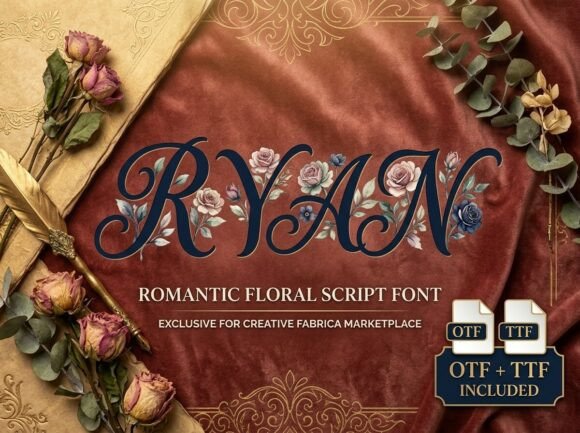
At its core, Ryan is classified as a floral script. This categorization implies specific design choices that differentiate it from formal scripts (like Copperplate) or casual scripts (like Brush Script). The defining characteristic of the Ryan font is its fluidity. The strokes mimic the natural pressure variations of a pointed-pen calligrapher, featuring distinct thick-to-thin transitions that create a sense of movement.
However, what elevates Ryan above a standard cursive font is its "floral" attribute. This is often achieved through the inclusion of ornamental swashes, extended ascenders and descenders, and stylistic alternates that mimic organic curves found in nature. In the context of digital design, these elements are not merely decorative; they are functional components that allow the designer to adjust the footprint of the text to fit various layouts. The architecture of Ryan allows for tight kerning and interlocking ligatures, which are essential for creating that "timeless passion" aesthetic where letters appear to dance around one another rather than sitting in isolated blocks.
Psychological Impact and Brand Identity
Typography is a silent ambassador for a brand. When a designer selects Ryan for a project, they are making a deliberate psychological statement. The visual language of the font triggers associations with elegance, tradition, and artisanal quality. This is why Ryan is frequently identified as the premier choice for luxury sectors.
In the realm of consumer psychology, serif and script fonts are often perceived as more "trustworthy" and "expensive" than their sans-serif counterparts. Ryan leverages this perception effectively. For a high-end jewelry brand or an artisanal perfume packaging line, the font serves as a visual shorthand for quality. It suggests that the product inside the packaging is crafted with the same care as the letterforms used to label it. Conversely, using a font like Ryan for a tech startup or a construction firm would likely create a cognitive dissonance, highlighting the importance of context in typographic selection.
Strategic Applications Across Industries
The versatility of Ryan is most evident in its application across diverse professional sectors. While the font maintains a consistent personality, its function changes depending on the medium.
1. Luxury Wedding Stationery
The wedding industry is perhaps the most natural habitat for the Ryan font. In this sector, the typography must communicate romance and formality simultaneously. Ryan is particularly effective for invitation suites, save-the-dates, and envelope addressing. Its ability to connect letters seamlessly allows for the creation of elegant headlines that draw the eye without overwhelming the supporting body text. Designers often pair Ryan with a classic serif or a clean sans-serif to create a hierarchy that guides the reader from the romantic headline to the functional details of the event.
2. Boutique Floral Branding
For florists, botanicals, and garden centers, branding must reflect the organic nature of the product. Ryan excels here because its stroke contrast and flow mimic the movement of plant life. It avoids the stiffness of geometric branding, offering a softer approach that feels approachable yet sophisticated. Whether used on business cards, van wraps, or signage, the font helps establish an identity that feels rooted in nature.
3. Artisanal Perfume and Cosmetics
Packaging design in the cosmetics industry relies heavily on shelf appeal. In a crowded market, a product has only seconds to communicate its value. Ryan is frequently utilized in this space to denote "bespoke" or "small-batch" qualities. The script style suggests a personal touch, implying that the scent or product was curated by an artist rather than mass-produced by a machine.
4. Editorial and Publishing
While body text in books and magazines requires high legibility, cover design and pull quotes offer room for typographic flair. Ryan is often used in lifestyle magazines, particularly in features related to culture, food, and art. It provides a visual break from the structured grid of editorial layouts, adding a layer of sophistication and visual interest to the page.
Implementation: Pairing and Legibility
One of the most common challenges in using expressive scripts like Ryan is maintaining readability. Because of its decorative nature, Ryan is best suited for display sizes—headlines, logos, and titles—rather than long-form paragraphs. Using it for body copy would quickly lead to eye strain for the reader.
Effective implementation of Ryan relies on the principle of contrast. A robust design system usually pairs the script with a secondary typeface that offers stability.
- Pairing with Serifs: Combining Ryan with a transitional serif (like Garamond or Baskerville) creates a classic, timeless aesthetic. This combination is ideal for wedding invitations and luxury branding where the goal is to evoke heritage.
- Pairing with Sans-Serifs: To modernize the look, designers can pair Ryan with a geometric sans-serif (like Montserrat or Futura). This contrast highlights the organic nature of the script while keeping the overall design feeling fresh and contemporary. This approach works well for modern boutiques or lifestyle blogs.
Additionally, attention must be paid to color and background. Ryan features thin hairlines in its strokes. If placed on a high-contrast background or printed on textured paper with low-resolution settings, these thin lines can break up or disappear. Therefore, high-quality rendering and sufficient contrast are technical prerequisites for using this font successfully.
The Role of Alternates and Ligatures
A key feature that defines the quality of a font like Ryan is the breadth of its glyph set. Standard alphabets often look disjointed when certain letter combinations collide—for example, the connection between a "b" and an "e" or a "w" and an "n." Professional-grade fonts like Ryan include contextual alternates and ligatures.
These features automatically swap out standard letters for special versions when specific combinations occur, ensuring a smooth, hand-lettered flow. For the end-user, this means that text set in Ryan looks less like a digital output and more like a scanned piece of calligraphy. Designers should ensure that these OpenType features are enabled in their software to fully realize the potential of the typeface.
Trends in Typography and the Future of Script Fonts
The design world is cyclical, and we are currently witnessing a resurgence of maximalism and personality in branding. After a decade dominated by the "Swiss Style" and ultra-minimalism, audiences are craving authenticity. Script fonts like Ryan play a crucial role in this shift. They represent a pushback against the sterile, algorithmic nature of modern digital interfaces.
However, the use of Ryan is evolving. It is no longer enough to simply slap a script font on a logo. Modern trends suggest a more integrated approach, where scripts are used as part of a larger typographic ecosystem. We see Ryan being used in kinetic typography—text that moves and animates—where its flowing lines create mesmerizing motion graphics. We also see it used in mixed-media collages, combining digital script with photography and hand-drawn illustration.
Considerations for Accessibility
While Ryan offers undeniable aesthetic value, designers must remain conscious of accessibility standards. Script fonts can pose challenges for individuals with dyslexia or visual impairments due to the irregular shapes of the letters and the lack of distinct separation between characters.
When using Ryan, it is a best practice to limit its use to decorative headlines where the text is large and high-contrast. Essential information, such as addresses, dates, times, or legal disclaimers, should always be set in a highly legible, accessible typeface. This ensures that the design remains beautiful without excluding any part of the audience.
Conclusion
The Ryan font is more than just a collection of vector paths; it is a tool for storytelling. Its ability to convey "timeless passion" makes it a valuable asset in the arsenal of any designer working within the luxury, wedding, or artisanal sectors. By understanding its technical structure, respecting its limitations regarding legibility, and pairing it thoughtfully with complementary typefaces, professionals can use Ryan to elevate their designs from mere graphics to evocative experiences. Whether applied to the label of a vintage wine or the header of a fashion editorial, Ryan serves as a bridge between the digital precision of today and the romantic artistry of the past.