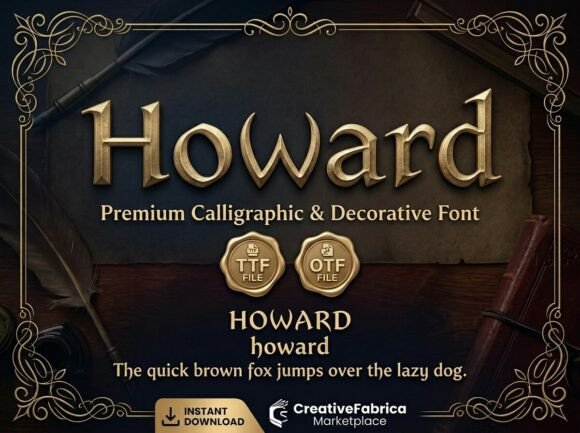
Howard: A Strategic Framework for Classical Sophistication in Design
In a visual landscape saturated with minimalist sans-serifs and playful scripts, the choice of typography is a critical strategic decision. It communicates value, ethos, and positioning before a single word of copy is read. Howard, a premium decorative font, is not merely an aesthetic choice but a tool for deliberate communication. Its chiseled, stone-cut texture and razor-sharp calligraphic terminals are engineered to evoke the gravitas of ancient manuscripts and royal heraldry. This is a typeface that doesn't just display text; it declares it.
The Anatomy of Intentional Design
Understanding Howard's construction is key to leveraging its strengths. It masterfully balances two seemingly opposing forces: the architectural strength of carved stone and the fluid grace of traditional broad-nib penmanship. This duality gives it a unique authority. The letterforms feel permanent, as if etched into a monument, yet they retain the humanistic flow of a master calligrapher's hand. This makes Howard exceptionally versatile for projects that demand both heritage and humanity. It avoids the coldness of purely geometric typefaces and the casualness of overly ornate scripts, striking a precise tone of cultivated elegance.
Strategic Applications: Where Howard Delivers Value
Deploying Howard effectively requires matching its inherent character to specific project goals. Its visual language speaks directly to contexts where legacy, exclusivity, and uncompromising quality are paramount. Consider it a foundational element in your visual strategy for the following:
- Luxury Spirit and Beverage Labeling: In a market where shelf appeal is everything, Howard's texture suggests craftsmanship, age, and premium ingredients. It communicates the story of the distillery or vineyard, anchoring the product in a tradition of excellence.
- Heritage Branding and Rebranding: For institutions, family-owned businesses, or brands with a storied past, Howard provides a visual shorthand for trust and endurance. It’s ideal for logos, monograms, and key messaging that needs to convey a legacy of service or artisanship.
- Commemorative Editorial and Publishing: Special edition book covers, anniversary magazines, or award ceremony programs benefit from Howard's dignified presence. It elevates commemorative content, making the subject feel historically significant and worthy of celebration.
- High-End Event Stationery: From wedding invitations for discerning clients to gala dinner programs or exclusive membership certificates, Howard sets an immediate tone of prestige and exclusivity, aligning the attendee's experience with the event's stature.
A Framework for Implementation, Not Just Application
Simply selecting Howard because it "looks fancy" is a strategic misstep. Its power is unlocked through thoughtful integration into a broader design and communication plan. Here is a practical approach to implementation:
1. Define the Contextual Goal First
Before opening your design software, articulate what Howard is meant to achieve. Is the goal to establish immediate authority for a new financial advisory? To evoke nostalgia for a heritage brand's re-launch? To signify exclusivity for a members-only club? The answer dictates how you will use it. Howard is a supporting actor that elevates the lead—your core message.
2. Master Pairing and Hierarchy
Howard's decorative nature means it is rarely the best choice for long-form body copy. Its strategic role is as a headline, subhead, or accent font. Pair it with a clean, highly legible serif or sans-serif for body text. For example:
- For a luxury brand manual: Use Howard for the cover title and chapter headings, paired with a timeless serif like Garamond or Caslon for explanatory text.
- For a commemorative poster: Let Howard dominate the main event title, but use a simple geometric sans-serif for date, location, and ticket information to ensure clarity.
This creates a visual hierarchy where Howard delivers the emotional punch and authority, while the secondary font ensures practical information is accessible.
3. Consider the Medium and Scale
Howard's intricate details demand careful consideration of output. At very small sizes, its sharp terminals and texture can become muddy or illegible, especially on low-resolution screens or standard office printers. It performs best at larger scales where its craftsmanship can be appreciated: on premium paper stock, engraved into materials, or displayed on high-definition digital screens. Always test its rendering in the final intended medium.
Navigating the Risks: Context is Everything
The very qualities that make Howard powerful can become liabilities when used without clear intention. The primary risk is tonal dissonance. Using this font for a children's toy brand, a casual tech startup's landing page, or a fast-food menu would create a jarring, inauthentic experience that undermines trust. Its formality can read as pretentious or out of touch if the brand voice and audience don't align with messages of heritage and luxury.
Another risk is overuse. Saturating a design with Howard dilutes its impact. When everything is declared with monumental authority, nothing stands out. Its strategic value lies in selective, high-impact deployment. Think of it as a signature spice—a little transforms the dish; too much overwhelms it.
Long-Term Value and Brand Cohesion
When integrated thoughtfully, Howard contributes to long-term brand equity. It becomes part of a cohesive visual system that consistently communicates your core values. For a brand built on tradition, it reinforces that narrative across every touchpoint—from a letterhead to a website banner. This consistency builds recognition and deepens audience trust over time. However, this requires a commitment. Adopting Howard means committing to the aesthetic and strategic territory it occupies. Changing it later can signal a brand pivot, so ensure it aligns with your long-term vision, not just a short-term project.
Practical Decision-Making: A Checklist
Before finalizing Howard for your project, run through this strategic checklist:
- Audience Alignment: Does my target audience value tradition, craftsmanship, and exclusivity? Would they respond to this visual language?
- Message Congruence: Does the content of my message match the font's tone? Is it about heritage, quality, celebration, or authority?
- Functional Role: Have I assigned Howard a specific role (e.g., hero headline, monogram) and paired it with a functional font for readability?
- Medium Suitability: Will the final output (print, digital, engraving) preserve the detail and legibility of the font?
- Scale of Use: Am I using it sparingly and at a size where its details can be fully appreciated?
- Brand Consistency: Does this choice fit within my broader brand identity system, or is it a one-off that might create confusion?
Ultimately, Howard is a tool for precision. It is not a universal solution but a specialized instrument for designers, marketers, and brand strategists who need to communicate a very specific set of values. By moving beyond aesthetic preference and into strategic application, you transform a decorative font into a cornerstone of meaningful visual communication. It becomes a deliberate choice that supports your goals, clarifies your positioning, and delivers a message of unwavering quality to those who matter most.